
New York Cycling and E-bike Law FAQ
10 questions about riding in New York: the e-bike rules, the roads and trails worth the trip, the season, and the events.
Questions and answers
What are the e-bike laws in New York?
New York has run a three-class e-bike system since April 2020, when New York S7508-B went into the state budget. Class 1 and Class 2 ride statewide, Class 3 is a 25 mph throttle class allowed only in New York City, and the state asks for no license, no registration, and no insurance. Every rider must be at least 16.
What is the difference between Class 1, Class 2, and Class 3 e-bikes in New York?
Class 1 helps only while you pedal and stops assisting at 20 mph. Class 2 adds a throttle that moves the bike without pedaling, also to 20 mph. Class 3 in New York is unusual: a throttle-capable bike good for 25 mph that is legal solely inside a city of one million or more, which means New York City and nowhere else in the state.
Who has to wear a helmet on an e-bike in New York?
Class 3 riders wear a helmet at every age under N.Y. VTL 1238, and riders under 14 wear one on any bicycle. Adults on Class 1 and Class 2 e-bikes decide for themselves. The minimum age to operate any class is 16, and a child under one may not be carried on a bicycle at all.
Where can I ride a Class 1, Class 2, or Class 3 e-bike in New York?
Class 1 and Class 2 e-bikes may use any road posted at 30 mph or less and any bike lane statewide (VTL 1281). Class 3 is confined to New York City. One thing to watch: sidewalks are closed unless a local law opens them, and New York City has capped e-bikes at 15 mph on its streets, bike lanes, and park paths since October 24, 2025.
What is the best long-distance ride in New York?
The Empire State Trail is the headline: 750 miles linking New York City to the Canadian border and Buffalo to Albany, most of it on dedicated paths and rail trails. The Erie Canalway Trail forms its east-west spine, 360 miles of towpath that is flat, car-free for long stretches, and dotted with canal towns every few miles. Spring through October is the window; sections of the canal path are gravel, so a gravel or hybrid bike is the comfortable choice.
Where do road cyclists ride in the Hudson Valley and the Adirondacks?
The Hudson Valley offers rolling river roads out of Cold Spring, Rhinebeck, and New Paltz, with the Shawangunk Ridge and Minnewaska State Park for climbers. Farther north, the Adirondacks deliver long, quiet climbs around Lake Placid and Keene Valley, and the Whiteface Veterans Memorial Highway is the state's signature mountain ascent. Battenkill, in Washington County, is the gravel pilgrimage.
What are the must-ride paths in New York City?
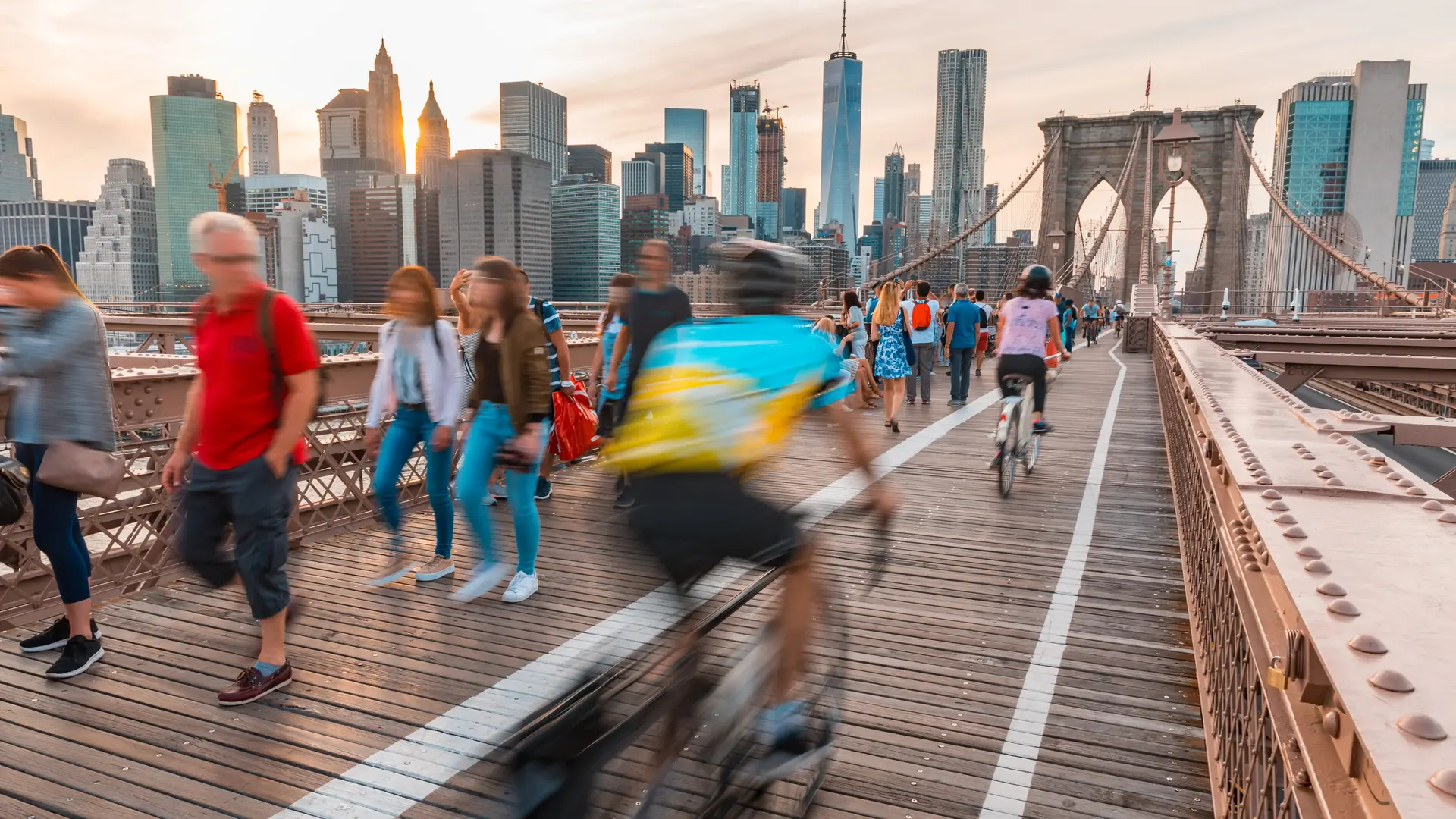
The Hudson River Greenway runs the length of Manhattan's west side with no cars, the Central Park loop and the Prospect Park loop are the city's training circuits, and the Brooklyn, Manhattan, and Williamsburg bridges carry dedicated bike paths across the East River. Remember the citywide 15 mph e-bike cap and that sidewalks are off-limits.
What cycling events draw the biggest crowds in New York?
The Five Boro Bike Tour in early May closes 40 miles of city streets to cars for tens of thousands of riders and is the largest recreational ride in the country. The Gran Fondo New York in May climbs out of the city toward Bear Mountain, and Harlem's Skyscraper Classic is the historic criterium. Upstate, the Tour de Battenkill is the gravel race to enter.
When is cycling season in New York?
April through October is reliable across the state, with September and early October the sweet spot for color in the Hudson Valley and the Adirondacks. New York City riders go year-round on cleared greenways, though winter brings salt, slush, and short days. Upstate rail trails can hold snow into April.
How bad is bike theft in New York?
New York City is the theft capital of the state: NYPD data for the first half of 2026 showed 1,766 reported bike thefts citywide, with Manhattan at 45 thefts per 100,000 residents and most incidents on the street in the summer evenings. A U-lock through the frame to a fixed rack, lights removed, and a photographed serial number are the baseline; the NYPD also runs a free registration and engraving program.
Law summaries are current as of October 2026 and are not legal advice; see the New York e-bike and bicycle laws page for statutes. Trail and event details change; check the organizer or land manager before you go.